
Change your browser to Desktop Site format for preferable newsletter layout

HFEM Newsletter | July 2026 | Page 3
HFE Columnist
Beyond the Ergonomic Chair:
Why Financial Stress is the Ultimate Workplace Hazard
Ask any ergonomist to audit a workspace, and you will likely see them measuring desk heights, assessing lumbar support, or evaluating the screen alignment of a workstation. In cognitive ergonomics, we might analyze interface clarity or mental workload during complex tasks. Yet, across offices, industrial plants, and remote workspaces, an invisible hazard routinely degrades human performance far more subtly than an unadjusted chair: FINANCIAL STRAIN!
Ergonomics, at its core, is the science of designing the environment to fit the human—optimizing system performance while safeguarding health and well-being. Historically, physical hazards dominated our focus. Today, the boundaries of cognitive and organizational ergonomics force us to ask a crucial question: What happens to human capabilities when an individual’s mental operating system is hijacked by economic survival?
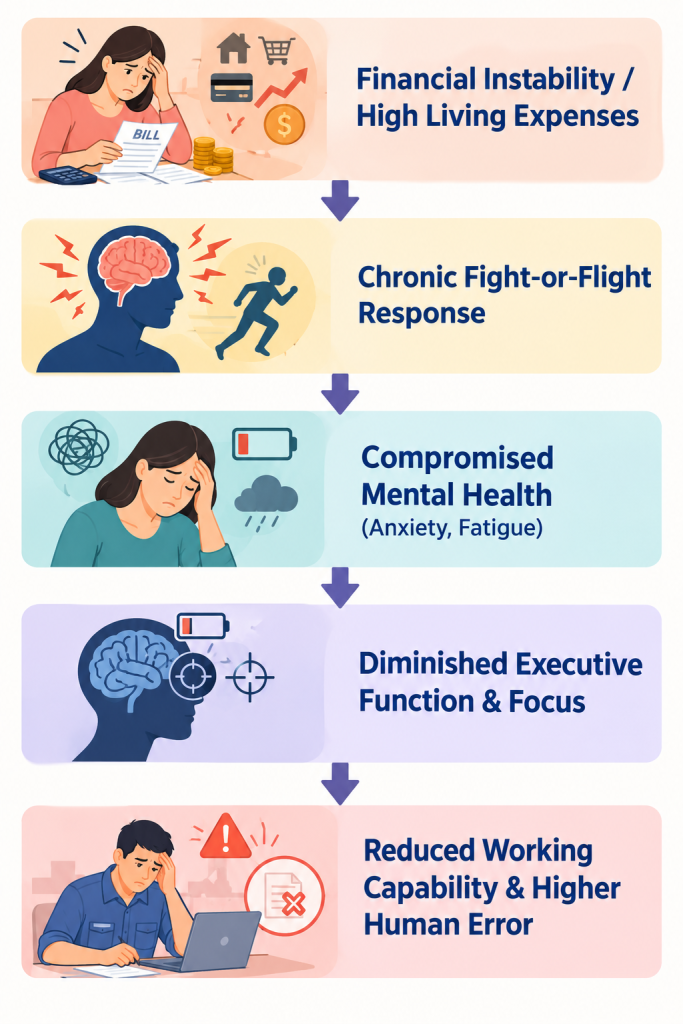
The Triad: Financial Health, Mental Health, and Working Capability
Financial instability is far more than an off-the-clock budgeting issue; it functions as a continuous cognitive drain that directly destabilizes mental health and working capability. When individuals face relentless economic pressures—particularly from core living expenditures such as housing, food, and transportation—the human brain interprets this state of insecurity as a persistent environment of threat. This activates a chronic “fight-or-flight” physiological response, elevating cortisol levels and preventing systemic psychological recovery
Over time, this continuous neurochemical strain weakens mental resilience, precipitating chronic anxiety, emotional exhaustion, and sleep disturbances. The resulting psychological fatigue severely degrades working capability: working memory capacity shrinks, reaction times slow, and high-level executive functions—such as strategic problem-solving, risk assessment, and emotional regulation—become impaired. In high-risk operational environments, this cognitive bandwidth tax manifests as increased human error and workplace accidents. In knowledge-based environments, it presents as severe presenteeism, where employees are physically present at their desks but cognitively offline.
Financial Ergonomics: Designing Cognitive BuffersIf we view financial distress as a system design flaw rather than merely an individual failure, we can apply human factors principles to mitigate its cognitive load. Just as we introduce micro-breaks to prevent physical strain, we can adopt strategies to reduce financial friction and reclaim mental bandwidth:Pacing Cognitive Decisions: Uncontrolled emotional spending often stems from dynamic stress responses seeking quick dopamine spikes. Implementing a deliberate “24-hour rule” for non-essential purchases creates a neurological cooling-off period, allowing the rational prefrontal cortex to regain control over impulse-driven spending. Building Shock Absorbers: In physical safety, buffers prevent systemic structural failure. Financially, automated savings (“paying yourself first”) build an emergency cushion that functions as a psychological shock absorber, preventing minor life disruptions from triggering acute panic. Reducing Isolation: Unspoken financial stress acts as a pressure cooker for mental fatigue. Fostering open communication—whether through workplace financial wellness programs or transparent household discussions—substantially lightens the psychological load
A holistic approach to ergonomics must account for the complete biological and psychological reality of the worker. We can build the most biomechanically perfect workspace in the world, but if an employee’s cognitive capacity is consumed by the anxiety of financial survival, neither health nor human performance can be sustained. True organizational ergonomics begins when we design work environments and support structures that protect both the body and the mind
Key Takeaways for Ergonomists & Workplace Leaders
- Financial Strain as a Cognitive Hazard:Economic distress acts as an ongoing psychological drain, keeping workers in a chronic “fight-or-flight” state that diminishes mental bandwidth, focus, and working memory.
- The Impact on Workplace Capability:Financial anxiety directly compromises mental health (causing fatigue and anxiety), leading to higher rates of presenteeism, impaired decision-making, and an increased risk of human error in operations.
- Beyond Physical Ergonomics:True workplace ergonomics must look beyond physical setups (chairs, desks, lighting) to address organizational and cognitive stressors—including financial wellness—to safeguard employee health and performance.
- Proactive Micro-Strategies: Applying basic human factors and behavioural principles—such as enforcing a “24-hour rule” for purchases, building emergency buffers (“paying yourself first”), and encouraging open communication—helps mitigate cognitive overload and restore focus.
Dr. Ummi Noor Nazahiah Binti Abdullah
Chief Editor @ Ergonomist Insight (HFEM)
Senior Lecturer, University Malaysia Perlis


HUMAN FACTORS AND ERGONOMICS SOCIETY MALAYSIA
C-8-1, Block C, Jalan Atmosphere 6, Pusat Perniagaan The Atmosphere, Bandar Putra Permai, 43300 Seri Kembangan, Selangor
Phone: 03-8314 3360 E-mail: secretary@hfem.org