
Change your browser to Desktop Site format for preferable newsletter layout

HFEM Newsletter | April 2026 | Page 3
HFE Columnist
Beyond Automation:
Why Industry 5.0 Puts People First
Beyond Automation: Why Industry 5.0 Puts People First
First of all, what is Industry 4.0 and when did it become Industry 5.0? Industry 4.0 focuses on efficiency and productivity at all costs. It is characterized by the use of smart technologies like the Internet of Things (IOT), cloud computing and highly advanced “smart factories”. This has created a system that is detrimental to human performance and well-being.
The Industry 5.0 concept gained significant traction and official recognition when it was formally introduced by the European Commission in 2021 through a policy briefing, solidifying its place in the global industrial conversation and strengthening its focus on sustainability and resilience through 2025. The shift is ongoing, representing a change in mindset from “efficiency at all costs” to a framework where systems must be built around people for ultimate success. Across Malaysia’s industrial heartlands, it can be seen that a fundamental shift is occurring. We are moving beyond the “efficiency at all costs” mindset of Industry 4.0 toward the Industry 5.0 framework: a vision where technology and automation serve the human worker, not the other way around.
The Reality Check: The Cost of “Late-Stage” or Afterthought Ergonomics
When Human Factors and Ergonomics (HFE) are treated as an afterthought, the consequences are both measurable and costly, with recent Malaysian studies offering a sobering look at the status quo. Few research studies have highlighted this. For example, a 2024 study in Shah Alam revealed a staggering prevalence of Work-related Musculoskeletal Disorders among solvent manufacturing workers, primarily driven by sustained awkward postures¹, while in Kelantan’s garment industry, nearly half of the workforce recorded “High Risk” RULA scores, indicating potential injury². Furthermore, the automotive sector is facing its own burden, as research in Selangor’s stamping plants found RULA grand scores that signal an urgent and critical need for workstation redesign across the industry³. These figures aren’t just health statistics—they represent lost productivity, increased medical leave, and expensive engineering rework.
Malaysian Snapshots: When HFE NOT in Action
The “heavy bag phenomenon”
Our children’s school bags serve as a classic example. While the primary concern is often the weight, attempts by the industry to address this without solid empirical data, such as anthropometric or biomechanical studies, rarely lead to optimal solutions. As evident in Figure 1, the resulting bags still negatively affect children’s posture; some are even wider than the children’s shoulders, demonstrating a clear design mismatch.

The “Perfect Fit” for Drivers
By embedding local anthropometry into vehicle seat design, researchers have moved beyond generic “global” averages. We now know that seat discomfort is a complex function of both static pressure and dynamic vibration. Using Malaysian-specific data ensures that our drivers are safer and less prone to fatigue-related accidents.
Digital Health & The UX Gate
In the digital realm, “usability” is the new safety standard. Whether it’s an AI chatbot for HIV prevention or a hospital information system (HIS), success depends on System Usability Scale (SUS) scores and User Experience Questionnaire (UEQ+) metrics. If a tool isn’t learnable or efficient, it won’t be used—no matter how advanced the code.
Rethinking Public Spaces
Even the simple act of ablution in public facilities has been reimagined through an HFE lens. By redesigning these spaces for hygiene, safety, and accessibility, we elevate the daily experience of all citizens, particularly the elderly and those with disabilities. In places like the airport and public toilets, design of sink heights, pipes and location of bidets for example are improved to suit the size of local users and friendlier (i.e. humanly).Human Factors Engineering (HFE) principles have been applied to even the seemingly simple act of ablution in public facilities. This reimagining involves redesigning these spaces—such as airport and public toilets—to prioritize hygiene, safety, and accessibility. Improvements include optimizing the design of sink heights, pipe placement, and bidet locations to be more humanly friendly and better suit the anthropometric needs of local users. Ultimately, these design enhancements elevate the daily experience for all citizens, especially benefiting the elderly and those with disabilities.
The HFE Integration Blueprint
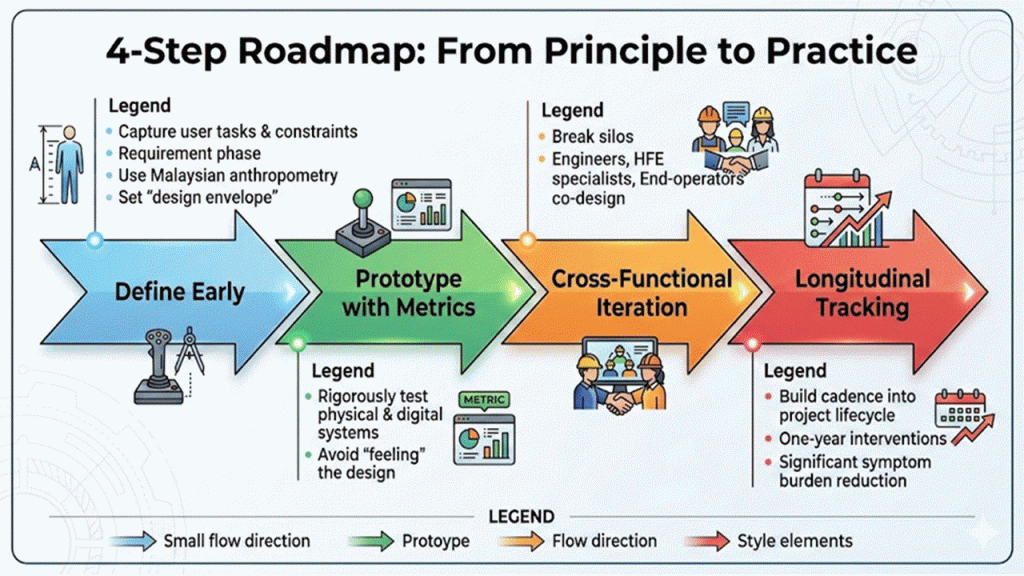
To move from principle to practice, engineering teams should follow a four-step roadmap. First, they must Define Early by capturing user tasks and constraints during the requirement phase, specifically using Malaysian anthropometry to set the “design envelope.” Next is Prototype with Metrics, which means not simply “feeling” the design but rigorously testing it for physical and digital systems. The third step is Cross-Functional Iteration, where silos must be broken so that engineers, HFE specialists, and end-operators can co-design the solution. Finally, through Longitudinal Tracking, the evidence is clear—one-year intervention programs involving training and redesign significantly reduce symptom burden, making it crucial to build this cadence into the project lifecycle. Figure 2 illustrates these steps clearly.
💡 Key Insights
The article highlights that integrating Human Factors and Ergonomics (HFE) early in system and product design leads to:
- safer workplaces,
- reduced musculoskeletal injuries,
- improved productivity,
- better user experience,
- and more inclusive public facilities.
Using Malaysian examples such as school bag design, vehicle seating, digital health systems, manufacturing workstations, and public facilities, the article demonstrates that designs based on real human needs, local anthropometry, and usability data create more sustainable and effective systems.
A central message is that ergonomics should not be treated as an afterthought because poor human-centered design causes health risks, productivity losses, and costly redesigns. Instead, organizations should adopt a structured HFE integration process involving:
- Early requirement definition,
- Metric-based prototyping,
- Cross-functional collaboration,
- Continuous monitoring and improvement.
Assoc. Prof. Dr. Dian Darina Indah Daruis
Department of Mechanical Engineering, Faculty of Engineering
Malaysia National Defence University

Successful HFE implementation follows a rigorous lifecycle: beginning with the definition of Requirements through task analysis and anthropometry to establish a human-centric baseline; progressing to Validation where design integrity is verified using objective physical metrics like the pen and paper assessments; extending into UX Testing to ensure digital accessibility through localized SUS or UEQ+ scales; and finally, sustaining performance through proactive Maintenance and longitudinal monitoring of exposure to prevent the recurrence of musculoskeletal risks.
Integrating HFE isn’t just about “comfort”—it’s about performance. When we design for the Malaysian worker and consumer, we create systems that are safer, more inclusive, and ultimately more successful.
Footnote:
1. Ali, N. F., & Najihah Roslan, A. N. (2024). Ergonomic Risk Factors (ERFs) and Prevalence of Work-related Musculoskeletal Disorders (WMSDs) Among Solvent Manufacturing Workers in Shah Alam, Selangor. Malaysian Journal of Medicine & Health Sciences, 20(5).
2. Khamarollah, N., Hamzah, N. A., Abd Rahman, S., Samsudin, K., Samad, N. I. A., Yasir, A. S. H. M., & Tamrin, S. B. M. (2024). Ergonomic Risk Assessment and Symptoms of Musculoskeletal Disorders among Garment Manufacturing Workers in Kota Bharu, Kelantan. Industrial Engineering & Management Systems, 23(1), 63-70.
3. Nor Azmi, M. K. A., & Udin, A. (2024). Design Analysis of Ergonomic Accelerator Pedal: A Case Study on Proton Persona SV. Featured in: Ng, Y. G., Daruis, D. D. I., & Wahat, N. W. A. (Eds.), Human Factors and Ergonomics toward an Inclusive and Sustainable Future. Springer Series in Design and Innovation, Vol. 46. Springer Nature.

HUMAN FACTORS AND ERGONOMICS SOCIETY MALAYSIA
C-8-1, Block C, Jalan Atmosphere 6, Pusat Perniagaan The Atmosphere, Bandar Putra Permai, 43300 Seri Kembangan, Selangor
Phone: 03-8314 3360 E-mail: secretary@hfem.org