
Change your browser to Desktop Site format for preferable newsletter layout

HFEM Newsletter | August 2026 | Page 3
HFE Columnist
Beyond the Assessment:
Bridging Ergonomic Risk Assessment (ERA) and Workplace Awareness
Ergonomic risk assessment (ERA) is indeed an important component of workplace ergonomics, providing a systematic approach to identifying and evaluating ergonomic risk factors. However, completing an assessment does not automatically result in sustainable workplace improvement. The findings need to be effectively communicated and translated into practical knowledge that both employees and management can understand and apply.
This article explores the relationship between ergonomic risk assessment, workplace education, and awareness. It is to discuss why technical assessment findings should be communicated in a practical and accessible manner, the importance of employees participation in understanding ergonomic risks, and the role of education in supporting the implementation and sustainability of ergonomic interventions. It highlights that education should complement, rather than replace, appropriate ergonomic controls.
Moving beyond a “find and report” approach allows ergonomics to become a continuous process of assessment, communication, participation and improvement. Ultimately, effective ergonomics is not only about identifying risks, but also about creating the knowledge and awareness needed to enable meaningful change in the way work is designed and performed across generations.
Ergonomics main concern is the interaction between people and the elements of the work system. In practice, this means considering how tasks, equipment, workspaces, organizational arrangements, and perception of employees that influence safety, health and performance of a workplace
Through systematic observation and assessment, ergonomic risk factors such as awkward postures, repetitive movements, excessive force, manual handling and other physical demands can be identified and evaluated. But it is always more than that.
Ergonomics goes beyond surface-level physical analysis. It correlates closely with psychosocial factors, behaviours, and employee perceptions regarding their work tasks and environment. Most importantly is the level of knowledge and awareness of what actually hurts them..
A technically sound assessment may identify an elevated risk, but the assessment itself does not change the way work is performed. Recommendations may be made, but their effectiveness depends on whether they are understood, accepted and implemented.
This raises an important question,
What continuous changes that stays after the assessment?
The answer lies partly in how effective assessment findings are translated into workplace education and awareness.
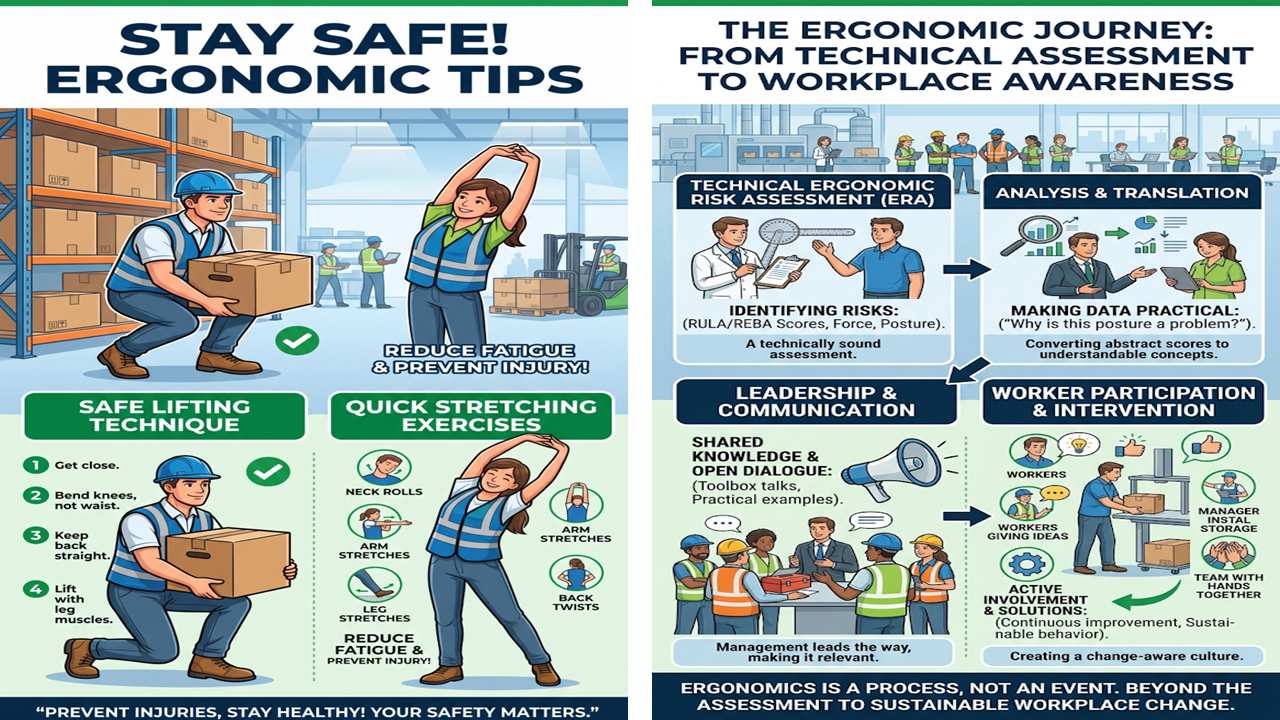
From Risk Identification to Risk Understanding
Ergonomic assessment tools provide structure to the assessment process.
Depending on the task and exposure, methods such as RULA, REBA, ROSA, QEC, RNLE, MAC, RAPP and other assessment approaches may be used to evaluate specific ergonomic risk factors. These tools provide useful information to support decision-making.
However, an assessment score alone may not be meaningful to the person performing the task. For example, identifying a high-risk awkward posture through an assessment method provides an indication that further action may be required. However, the worker may still ask:
Why is this posture a problem?
Which part of the task is contributing to the risk?
What can I do differently?
Will the changes cause my work to be more complicated?
Can the changes really last?
This highlights the difference between identifying risk and understanding risk.
The first is primarily an assessment function. The second requires communication and education.
DOSH’s Guidelines on Ergonomics Risk Assessment at Workplace 2017 provides a systematic approach to identifying, assessing and controlling ergonomic risk factors and also recognizes the importance of ergonomics awareness training and education.
Therefore, ERA should not be viewed as an isolated activity. It should form part of a broader process that enables the organization and its workforce to understand and manage ergonomic risks.
Why Education Matters in Ergonomics
Workplace education can help bridge the gap between technical assessment and practical application.
Consider a workstation assessment that identifies prolonged neck flexion. A technical report may describe the posture, exposure duration and associated risk level. However, an effective awareness session could translate the finding into a practical explanation.
What is happening?
The worker is frequently looking downward for prolonged periods.
Why does it matter?
Maintaining the position for extended periods may increase physical demand on the neck and upper back.
Why is it happening?
The workstation, equipment placement or task requirements may encourage the posture.
What can be changed?
The work height, equipment position, task arrangement or other relevant factors may be reviewed. Quick stretching sessions between tasks.
This approach allows the assessment finding to become a learning opportunity. The purpose of education is therefore not simply to provide more information.It is to make information relevant, understandable and actionable.
Translating Technical Language into Practical Language
One of the challenges in workplace ergonomics is communicating technical findings to individuals with different levels of knowledge.
Terms such as “awkward posture”, “forceful exertion”, “repetition”, “exposure duration” and “risk score” may be familiar to ergonomics practitioners but may not have the same meaning to workers.
Effective communication requires translation. Instead of focusing only on assessment terminology, practitioners can connect the finding to the actual task.
For example, a technical finding stating, ‘Assessment identified awkward posture and forceful exertion during manual lifting,’ can be translated into practical terms: ‘The weight of the items and their low storage placement cause excessive strain on the lower back during lifting.
This change in language does not reduce the technical accuracy of the assessment. Instead, it makes the finding easier to understand and discuss as employees can actually visualize what is happening.
The same principle applies to awareness materials, toolbox meeting, training sessions and workplace demonstrations. Simple explanations, practical examples and hands-on approaches can help workers connect ergonomic principles with their everyday activities. In a simple term is by using a layman’s term suitable to their understanding.
The Importance of Understanding the Work
An ergonomic assessment should not focus solely on the worker’s posture. It should also consider why the task is performed that way.
This is why worker participation is valuable during ergonomic assessment. Workers often have detailed knowledge of the task that cannot be obtained through observation alone.
They can explain which part of the process is most demanding, which equipment is difficult to use, when discomfort usually occurs and what practical barriers may prevent a recommended change from being implemented.
“If employees don’t know enough about them, they won’t know what to do to prevent them.”
This highlights the importance of ensuring that employees are not merely recipients of ergonomic recommendations, but participants in understanding and managing ergonomic risks for themselves.
Awareness is often considered the first step towards behavioural change, but awareness should not be the final objective. The goal should be to encourage participation.
There is a difference between telling a worker:
“This is an ergonomic risk.”
and enabling the worker to say:
“I see this risk in my own work, and I understand what can be done about it.”
The second represents a deeper level of engagement. When employees are able to recognize ergonomic risk factors, they can become an additional source of information for the organization.
They may identify emerging problems before they become the subject of a formal assessment. They may suggest improvements based on their practical experience and they may also be more likely to maintain an intervention once it has been introduced. This creates a shift from ergonomics being something conducted for workers to something conducted with workers.
Conclusion
Ergonomic risk assessment provides an important foundation for identifying and evaluating workplace risks. However, assessment should not be viewed as the final destination.
The findings need to be communicated, workers need to understand the risks, management needs to understand the reasons for intervention and both need opportunities to participate in developing practical solutions.
Education therefore serves as an important bridge between assessment and action.
It does not replace engineering or organizational controls, nor should responsibility for ergonomic risks be placed solely on individual workers. Instead, effective education supports people in understanding the work, recognizing risks and participating in sustainable improvements.
The success of ergonomics should not be measured only by how accurately a risk is assessed. It should also be reflected in what happens after the assessment.
An assessment identifies the risk. Education creates understanding. Participation turns understanding into action and that is where ergonomics can move beyond the checklist. Its by creating work that is not only safer and healthier, but better designed for the people who perform it.
References
Department of Occupational Safety and Health (DOSH). (2017). Guidelines on ergonomics risk assessment at workplace 2017. Ministry of Human Resources, Malaysia.
Key Takeaways for Ergonomists and Workplace Leaders
Move beyond a “find and report” approach: Technical assessment tools (such as RULA, REBA, ROSA, or MAC) and risk scores are only the starting point; risk identification alone does not automatically result in workplace change.
Translate technical jargon into practical language: Replace abstract terms like “forceful exertion” or “awkward posture” with simple, task-based language that workers can visualize and relate to their daily routines.
Conduct assessments with workers, not just for workers: Involve workers directly during evaluations to uncover task-specific nuances, timing of discomfort, and practical barriers that observation alone cannot reveal.
Use education to make findings actionable: Transform technical reports into practical learning opportunities using toolbox talks, visual demonstrations, and clear explanations of why a task poses a risk and how it can be altered.
Treat ergonomics as a continuous process, not a one-time checklist: Completing an Ergonomic Risk Assessment (ERA) report is not the final objective; long-term impact requires ongoing education, communication, and risk management.
Education complements—rather than replaces—engineering controls: Training and awareness help workers understand risks, but leadership must ensure that responsibility is not shifted solely onto individual workers; systemic, engineering, or organizational controls remain essential.
Foster worker participation to sustain interventions: Transitioning employees from passive recipients of recommendations to active participants enables them to identify emerging risks early and increases long-term compliance with workplace modifications.
Redefine program success metrics: Evaluate the success of ergonomics initiatives by what happens after the assessment—focusing on task redesign, sustainable behavioral changes, and risk reduction rather than just report completion.
Miss Dania Aniesha Binti Abdul Harith
OSH Officer
University Science Malaysia (USM)


HUMAN FACTORS AND ERGONOMICS SOCIETY MALAYSIA
C-8-1, Block C, Jalan Atmosphere 6, Pusat Perniagaan The Atmosphere, Bandar Putra Permai, 43300 Seri Kembangan, Selangor
Phone: 03-8314 3360 E-mail: secretary@hfem.org