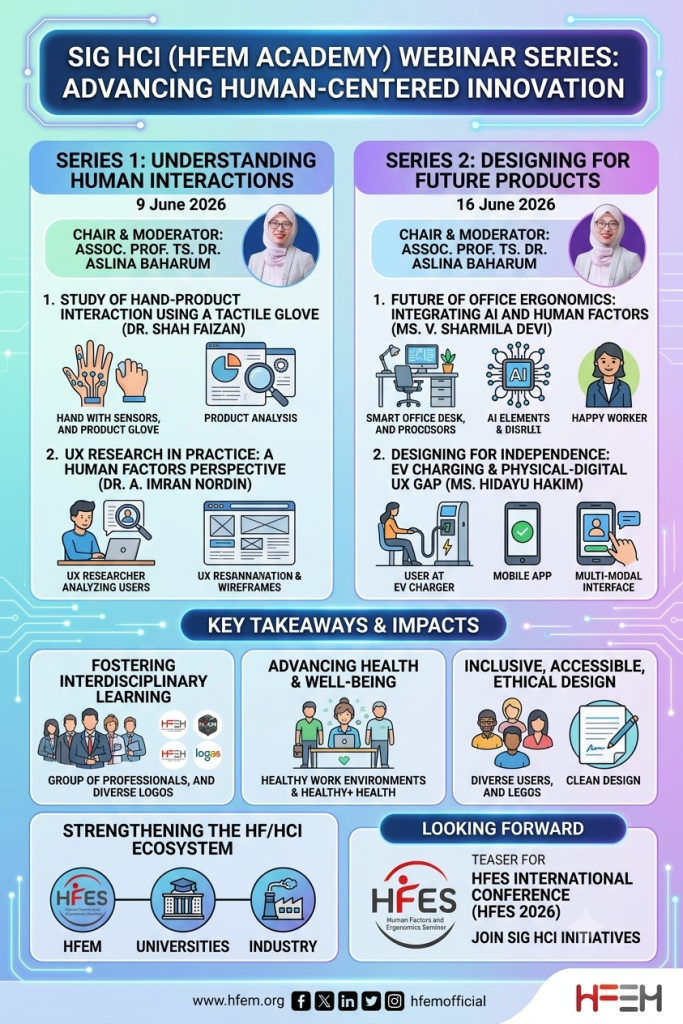
Both webinars were chaired and moderated by Associate Professor Ts. Dr. Aslina Baharum, Chair of SIG Human-Computer Interaction (HCI), HFEM Academy, who facilitated engaging discussions and knowledge exchange between speakers and participants while emphasizing the importance of human-centered approaches in addressing contemporary technological and societal challenges.
The webinar series served as a platform for interdisciplinary learning, highlighting how Human Factors, Ergonomics, User Experience (UX), and Human-Computer Interaction (HCI) contribute to the design of technologies, products, services, and environments that are effective, inclusive, accessible, and meaningful for people.
The first webinar featured distinguished speakers from academia and industry who provided complementary perspectives on understanding human needs and interactions in the design process. Dr. Shah Faizan from the IDC School of Design, IIT Bombay, India, delivered an insightful presentation titled “Study of Hand-Product Interaction Using a Tactile Glove.” His work demonstrated how tactile sensing technologies can be used to better understand hand-product interactions, providing valuable data that supports evidence-based product design, usability evaluation, and human-centered innovation.
The second session was presented by Dr. A. Imran Nordin, UX Research Specialist, who shared practical industry insights through “UX Research in Practice: A Human Factors Perspective.” His presentation emphasized the importance of understanding user behaviours, motivations, needs, and contexts to create products and services that resonate with real-world users and deliver meaningful experiences. A key message emerging from Webinar Series 1 was that successful innovation is not solely driven by technological advancement. Rather, it begins with understanding people, their capabilities, limitations, experiences, and expectations. Human Factors and UX research provide the foundation for designing solutions that are usable, accessible, inclusive, and aligned with human needs.
Building upon the foundations established in Series 1, the second webinar on the 16th June 2026, shifted the focus toward the application of Human Factors principles in emerging technological and service ecosystems.
Ms. V. Sharmila Devi, Founder and Director of Ergonomic Healthcare India, presented “Future of Office Ergonomics: Integrating AI and Human Factors.” Her session explored how Artificial Intelligence is transforming modern workplaces and highlighted the importance of integrating ergonomics and human-centered design principles to ensure employee wellbeing, safety, comfort, and productivity in AI-enabled environments.
The second presentation by Ms. Hidayu Hakim, UX Lead at Stampede, addressed “Designing for Independence: EV Charging and the Physical-Digital UX Gap.” Through real-world examples, she illustrated the challenges users encounter when navigating physical and digital touchpoints within electric vehicle charging ecosystems. Her presentation underscored the need for seamless, inclusive, and accessible experiences across the entire user journey.
Together, the presentations reinforced an increasingly important reality: as technologies become more intelligent, connected, and autonomous, the role of Human Factors and HCI becomes even more critical. Human-centered approaches remain essential to ensuring that technological innovation enhances rather than complicates human experiences.
A unique strength of both webinar sessions was the active engagement between speakers and participants. Through interactive discussions, audience reflections, live polls, and question-and-answer sessions, participants shared perspectives on AI, ergonomics, user experience, accessibility, and the future of human-centered innovation.
The webinars attracted participants from universities, industries, government agencies, and professional communities, creating valuable opportunities for interdisciplinary dialogue and collaboration.
The discussions consistently highlighted a shared understanding that while technologies continue to evolve rapidly, their success ultimately depends on how well they support human needs, capabilities, wellbeing, and experiences.
Beyond knowledge sharing, the webinar series demonstrated SIG HCI’s commitment to strengthening the Human Factors, Ergonomics, UX, and HCI ecosystem in Malaysia and beyond. By connecting researchers, practitioners, educators, and students, the initiative contributes to building a vibrant community dedicated to advancing human-centered research, practice, and innovation.
The success of both webinar series reflects the growing interest in Human Factors and HCI as essential disciplines for addressing challenges related to Artificial Intelligence, digital transformation, accessibility, smart systems, future workplaces, and emerging technologies.
Looking Forward
As Human Factors and HCI continue to play an increasingly important role in shaping the future of technology and society, SIG HCI remains committed to providing platforms for knowledge exchange, professional development, networking, and collaboration.
Members and interested professionals are encouraged to continue engaging with the community through upcoming SIG HCI initiatives and the Human Factors and Ergonomics Society Malaysia International Conference (HFES 2026), which will bring together researchers, practitioners, industry leaders, and policymakers to explore emerging trends and innovations in Human Factors, Ergonomics, UX, and Human-Computer Interaction.
Together, we can continue advancing technologies and systems that are not only innovative and intelligent, but also inclusive, accessible, ethical, and designed for people.
The Special Interest Group on Human-Computer Interaction (SIG HCI) under the Human Factors and Ergonomics Society Malaysia (HFEM) Academy hosted a two-part webinar series titled “Human Factors in Product and Service Development” in June 2026. Chaired and moderated by Assoc. Prof. Ts. Dr. Aslina Baharum, the series brought together researchers, practitioners, and industry experts to explore how human-centered design shapes modern technology.
Data-Driven Tactile Sensing: Dr. Shah Faizan (IIT Bombay) demonstrated how tactile glove technology captures real-time data on hand-product interactions to build evidence-based product designs.
UX Research in Practice: Dr. A. Imran Nordin (UX Research Specialist) emphasized evaluating user behaviors, motivations, and contexts to build products that resonate in real-world scenarios.
Core Insight: True innovation begins with people—not technology. Human factors provide the bedrock for creating accessible, usable, and inclusive tools.
AI & Office Ergonomics: Ms. V. Sharmila Devi (Ergonomic Healthcare India) discussed integrating ergonomic principles into AI-driven workplaces to protect employee well-being, safety, and productivity.
Bridging the Physical-Digital UX Gap: Ms. Hidayu Hakim (Stampede) highlighted user experience challenges in Electric Vehicle (EV) charging ecosystems, advocating for seamless journeys across physical and digital touchpoints.
Core Insight: As systems grow autonomous and intelligent, human-centered approaches become even more vital to ensure technology simplifies—rather than complicates—human lives.
Cross-Sector Collaboration: The webinars engaged diverse participants across academia, industry, government agencies, and student communities through live polls, reflections, and Q&A sessions.
Strengthening HF/HCI in Malaysia: The event reinforced SIG HCI’s mission to build a vibrant ecosystem supporting digital transformation, smart systems, and ethical, human-first technology.
Following the success of the webinar series, HFEM announced the upcoming Human Factors and Ergonomics Seminar 2026 (HFES 2026):
Theme: “Advancing Health and Well-being through Human Factors and Ergonomics”
Date & Location: 1 September 2026 at Bangi Resort Hotel, Selangor
Key Speakers: Ir. Ts. Md Idris Salim (Cognitive Ergonomics), Datin Dr. Zoharah Omar (Organizational Ergonomics), and Mr. Go Chang Hua (Physical Ergonomics).

Associate Professor Ts. Dr. Aslina Baharum
Â
Chair, Special Interest Group on Human-Computer Interaction (SIG HCI)
Human Factors and Ergonomics Society Malaysia (HFEM)
Associate Professor, The Design School, Faculty of Innovation and Technology
Taylor’s University, Subang Jaya, Selangor
Â
HFEM Newsletter (June 2026)Â Â |Â Page 3
HUMAN FACTORS AND ERGONOMICS SOCIETY MALAYSIA
C-8-1, Block C, Jalan Atmosphere 6, Pusat Perniagaan The Atmosphere, Bandar Putra Permai, 43300 Seri Kembangan, Selangor
Phone: 03-8314 3360Â Â Â Â Â Â Â Â Â E-mail: secretary@hfem.org